Are There Car Parts You Shouldn’t Buy Second-Hand?
Yes, definitely. While many parts on a car can be reused without issue, some parts are best
avoided used due to safety or wear concerns. Typically, anything that
wears out or degrades with use – especially if it’s critical to safety – you should plan to buy new. For example,
filters (oil filters, air filters),
belts (timing belts, drive belts), and
spark plugs are routine maintenance items and should always be new because they have limited service life. Here are a few parts frequently cited by mechanics as
“do not buy used”:
- Brake Consumables: Your braking system’s performance is literally life-or-death. While big components like brake calipers can be bought used (and then refurbished), you should not buy used brake pads or brake discs (often called brake plates). These wear down with use. Used pads and discs will likely be partially worn or could have heat damage – starting with those will just give you subpar braking and they’ll need replacement again soon anyway. Always get new pads/discs for proper stopping power.
- Filters and Fluids: As mentioned, oil filters, fuel filters, and engine oil itself are off the list – those must be new. It might sound silly, but people have tried reusing old filters; it’s false economy. The same goes for things like engine oil, coolant, brake fluid – always fresh. (Most reputable parts sellers wouldn’t even offer used filters/fluids, but it’s worth stating.)
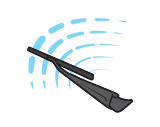
- Wiper Blades: Windscreen wiper blades are cheap enough new, and they degrade with time and use. A used set from a scrapyard will likely be dried out or streaky. You don’t want to compromise visibility in rain – buy new wipers when needed.
In short, if a part’s effectiveness is significantly reduced by age/use (or if failure of that part could cause a major safety issue), it’s usually best to buy brand new for peace of mind. But for
most other parts – especially big-ticket items – going used can be a brilliant decision as long as you choose carefully. The key is ensuring the used part you buy is
compatible with your car and in good condition. That brings us to the next major question: how do you make sure a used part will actually fit your specific vehicle and work properly?
How Can You Ensure a Used Car Part Will Fit Your Vehicle?
One of the biggest concerns when buying a car part (new or used) is
compatibility. Cars have many variations even within the same model – different trims, engines, facelifts, and year-to-year changes can mean a part from a similar car might not be an exact match for yours. When shopping used parts, you can’t just go by a vague description like “Golf radiator 2008-2012” and assume it will fit all Golfs in that range. To get it right, you’ll want to use the
same exact part number or other specific identifiers. Here’s how to make sure you’re getting a like-for-like replacement:
What Is an OEM Part Number (and Why Does it Matter)?
“
OEM number” stands for
Original Equipment Manufacturer part number. It’s a unique code assigned by the vehicle manufacturer to each specific part. Think of it as the part’s fingerprint or ID card. For example, a Ford Focus headlight might have an OEM number like
4M51-13008-xx. If you have that number, you can be confident you’re getting the exact same headlight design.
Matching the OEM part number is the gold standard for ensuring compatibility when buying used parts – it’s far more reliable than just matching by model and year.
Every original part on your car has an OEM number, often stamped or printed on the part itself. Savvy mechanics will often remove the broken part first and check for this number. If you can locate it (sometimes you might need to wipe off dirt or look on the back side of a component), you’ve struck gold. For instance, an alternator might have a label with a Bosch logo and a long number on it – that’s the OEM or supplier part code. With that in hand, you can search online or tell a dismantler, “I need this exact part number.” This eliminates guesswork because the number encodes exactly what variant the part is.
Why is this so important? Because manufacturers often have multiple versions of a part. Say your car is a 2010 model – the part you need might have changed in 2011, even if the car looks the same. By using the OEM number from your specific broken part (or from the parts catalog for your VIN), you ensure the
used replacement is
identical in form and function. It’s like verifying the DNA of the part.
How Can Your VIN or Registration Number Help Find the Right Part?
The
VIN (Vehicle Identification Number) is your car’s unique 17-character identity code. It’s like your car’s birth certificate.
The VIN can reveal a wealth of information about your specific vehicle – the exact model variant, the engine type, the factory it was built in, and so on. This is incredibly useful for parts matching. Many modern parts databases and online platforms allow you to search for parts by VIN, which then filters results to parts that fit
that exact vehicle. In other words, the VIN is a key that unlocks your car’s detailed build sheet.
For example, if you enter your VIN on a parts website or give it to a dismantler, they can usually pinpoint exactly which part numbers correspond to your car’s components. This is especially handy if you’re not sure which version of a part you need. Cars often have mid-year updates or slight changes by region. A part for a “2015 model” might depend on whether it was built before or after August 2015, etc. By using the VIN, you avoid those pitfalls – the system will only show parts that match your specific car. As the Vehicle Recyclers’ Association (VRA) advises, always provide the car’s registration number (which links to the VIN) or VIN code when inquiring about a part; this info allows the dismantler’s database to find the right part for your vehicle. It’s the best way to avoid getting the wrong item.
Some online marketplaces (including Autoparts24) have
smart search tools where you can input your car’s registration or VIN, and the site will automatically filter the inventory to compatible parts. This is a godsend for those of us who aren’t walking automotive encyclopedias – you don’t need to know the part number off-hand, because the VIN search figures it out for you. It drastically reduces the risk of ordering something that “looks” right but isn’t. So whenever possible, leverage your VIN when searching for parts online. It brings peace of mind that the results you see are truly for
your car.
Why Are Engine Codes and Gearbox Codes Important?
If you’re hunting big items like an engine or transmission, you’ll quickly encounter
engine codes and
gearbox codes. These are specific identifiers (usually a mix of letters/numbers) that car manufacturers use to denote a particular engine variant or gearbox type. For example, a Volkswagen 2.0 TDI diesel might have engine code
“BKD”, whereas a slightly revised version of that engine might be
“BMM”, etc. Two engines might both be 2.0 TDI, but if their codes differ, there could be differences in compatibility (mountings, sensors, tuning, etc.). Therefore, matching the
engine code is crucial when buying a used engine or certain engine parts.
The same goes for gearboxes: the gearbox code (sometimes called transmission code) ensures you get the exact type (gear ratios, 5-speed vs 6-speed, etc.) that your car expects. If you put the wrong variant in, you could face anything from mounting issues to software incompatibility. For instance, a gearbox from a 1.4 petrol might physically bolt up to a 1.4 diesel (hypothetically), but the gear ratios and bellhousing could be different – meaning it won’t function correctly for you.
When buying engines, the
VRA strongly advises obtaining the
correct engine code (note: this is
not the same as the engine
serial number, but the code for the engine model) to ensure you order the right one. You can usually find your engine code on the identification plate under the bonnet or in the service book. Similarly, the gearbox code might be on a sticker or plate on the gearbox or in documentation.
Many platforms let you filter or search by engine/gearbox codes. On Autoparts24, for example, you can refine your search results by specifying the engine code or gearbox code, which helps zero in on exactly compatible parts. This means if you need a
used gearbox, you can enter the gearbox’s code and see only the units that match, say, a Ford “MTX-75” transmission or a BMW “GS6-53DZ” (whatever the code may be). Using these codes eliminates the ambiguity, much like OEM part numbers do.
What Should You Look for When Buying a Used Car Part (Quality & Trust)?
Once you’ve identified the part you need and have some candidates available (perhaps you’ve found several listings online or a few local breakers that have it), how do you evaluate these options? Buying used means you have to be a bit more discerning about
condition and source. Here are some practical tips to ensure you get a quality part from a trustworthy source:
- Check the Part’s Description and Condition: A reputable seller will provide details about the used part’s condition. Look for descriptions like tested, working, grade A/B/C condition, and notes of any damage or wear. Many online platforms include multiple photos of the actual part being sold. Scrutinize the images – do you see any cracks, rust, or significant wear? A bit of grime or surface rust is normal for used parts, but structural damage or excessive corrosion is not. If the listing says “untested” or “for spares/repairs,” understand that it may not function properly (and the price should reflect that). Ideally, stick to parts listed as tested or with some guarantee of functionality. According to industry guidance, any part sold as “tested” should function correctly, whereas an “untested” part might be a gamble. Fortunately, all reputable vehicle dismantlers offer at least a short guarantee on off-the-shelf parts – so look for mentions of a warranty or returns policy (more on that below).
- Mileage of the Donor Vehicle: If available, note the mileage of the car the part came from. For mechanical items like engines, gearboxes, alternators, etc., lower mileage is generally better (less wear). Many online marketplaces will list the donor car’s year and mileage alongside the part. For example, you might see an engine for sale: “2.0 TDI engine (Code BMM) – 80,000 miles – from a 2012 Audi A3.” That gives you an idea of how much life it might have left. It’s not a perfect metric (a well-maintained 100k mile engine can be better than an abused 50k engine), but it’s one reference point. If mileage isn’t listed, you can inquire with the seller.
- What’s Included with the Part: Especially for larger components, clarify what comes in the sale. An engine, for instance, might be sold as a “bare engine” (no alternator, starter, turbo, etc.) or as a “complete engine” with ancillaries. The VRA notes that when buying an engine, often things like the alternator, power steering pump, starter motor, or turbo may not be included unless stated. So if you need those, ask beforehand to avoid surprises. The same goes for other parts – e.g., a used door might not include the interior door card or window regulator; an ABS pump might be sold with or without its control module. Reputable sellers usually specify this, but if it’s not clear, don’t assume – ask. It can save you from getting half of what you need.
- Verify Part Numbers and Codes Again: When you receive the part (or if you go to pick it up), cross-check any identifiers on it with what was advertised. Mistakes in listings can happen. Ensure the OEM number or code on the part matches your requirement. If you spot a discrepancy on delivery, you should raise it immediately before installation. It’s good practice to do this verification so you maintain the right to return it if it’s wrong. A quick tip: many sellers include the OEM number in the listing; if they’ve taken a photo of the part label, all the better – compare that to your original or to the catalogue info you have.
- Warranty or Return Policy: One big question: what if the used part doesn’t work or isn’t a correct fit? Check if the seller offers a warranty or returns. Many professional breakers offer a standard warranty like 30, 60, or 90 days on used parts. For example, a reputable scrapyard might give a 30-day exchange on electronic parts, or a 90-day warranty on engines/gearboxes (common in the UK). Online platforms often have built-in return policies – for instance, if you order through a marketplace and the part arrives Dead-on-Arrival or significantly not as described, you can return it. Knowing you have that safety net is important. If a seller says “no returns” on a part, be cautious – that’s more typical for “untested” cheap parts sold as-is. But if you’re paying a decent amount, you should have some assurance. Always get a receipt or invoice that shows the business details and what you bought; not only is this useful for returns, but it also helps ensure you’re buying from a legitimate source (which matters for avoiding stolen parts, etc.). In the UK it’s recommended to get proper documentation for any used part purchase.
- Seller Reputation and Credentials: If you’re buying online, check the seller’s ratings or reviews. On a platform or e-commerce site, a high rating with lots of sales is a good sign that they’re trustworthy. If it’s a standalone breaker yard, consider if they are a certified or well-known dismantler (for instance, VRA member yards adhere to standards). One advantage of using a marketplace is that they often vet their sellers – for example, Autoparts24 works only with trusted, professional breakers in their network, and parts are typically quality-checked and catalogued properly before listing. That means by the time you see a part online, it’s already been through an inspection and any flaws are noted. Such transparency lets you buy with more confidence. If you’re dealing directly with a scrap yard, you might not have that info upfront, so asking questions and relying on reputation is key.
- Price vs. Value Considerations: Finally, evaluate the deal in front of you. The cheapest option isn’t always the best if the condition is poor or the seller dubious. Compare prices among the available options for the same part. If one breaker is selling an engine for £500 with a 3-month warranty and known mileage, and another has the “same” engine for £300 but with no info or guarantee, the £500 option might actually be the better value for most buyers. Be wary of prices that seem “too good to be true.” If a used part is extremely cheap compared to others, ask why – is it high mileage? Does it have damage? Sellers will usually price parts in line with their condition and demand. So a big outlier could indicate a catch. On the flip side, some sellers might overcharge – doing a quick comparison online will help you know the going rate. The beauty of online shopping is you can often see multiple listings side by side. For instance, you might find three offers for the same OEM part: one in the UK, one in Poland, one in Spain. Look at their prices, shipping, condition notes, and warranties to decide which offers the best overall value for you.
In summary, treat buying a used car part a bit like buying a second-hand car:
do your due diligence on the part’s condition and the seller’s reliability. The good news is that by using established channels and asking the right questions, you can mitigate most of the risk. And remember, thousands of people successfully buy used parts every day – so it’s certainly doable and can be very rewarding (especially when you save a bundle and your car is back on the road!).
Next, we’ll explore the bigger picture of
where to look for parts – comparing the local scrapyard route to the increasingly popular online marketplaces – and specifically, why broadening your search to Europe-wide (not just your local area) can make a huge difference.















































_logo.png "Landwind (jmc)")












_logo.png "Mg (saic)")